
Andy Warhol, Hammer and Sickle with Big Mac, 1976
At the Warhol exhibit at The Whitney, in a glass case at the end of a wall, towards the end of the exhibit and surrounded large and both well-known and less known pieces, is a group of small, gray, low contrast photographs. These were produced to be made into larger silk screen ‘paintings’. Of these, one photograph landed as possibly my favorite piece in the show; a photograph of hammer and sickle with a Big Mac. (There was also a related one of a hammer and sickle with a loaf of wonder bread). The paintings made from these photographs have been written about and are more familiar, however somehow these small photographs feel like they have more impact and are funnier.
As somebody who gives primary value to the visual experience it’s surprising to me that I should respond to something so dull in appearance. At the time that this work was made the US and USSR were still locked in the embrace of The Cold War. That this image is so blunt and undramatic stands in stark contrast to the high stakes of potential nuclear annihilation.
What struck me though is that this image can be seen as prophetic. I’m not claiming clairvoyance on the part of Warhol; however, from where we stand the inclusion of these actors on this still-life stage, in this way, makes me consider how these two countries have become more alike than could have been expected, and not in a good way. Hegelianly speaking the opposing theses of Democratic Capitalism and Communist Totalitarianism have synthesized into a paradigm of Totalitarian Capitalism. Certainly that seems to be the direction we’re moving as Russia and The US take on the worst qualities of the other. This, though not the image, makes me think of one of the opening passages from Macbeth, describing an ongoing battle in terms of two spent swimmers grappling together and so both drowning.
This reflection brings the piece in line with the morbid aspect of Warhol, which runs underneath the dominant layers of humor, irony, distance and shallowness. For all that snarky humor and distance, and all that I may be projecting too much into this piece, I can’t shake this odd little image and with it, grief for the present and future that we have collectively created.




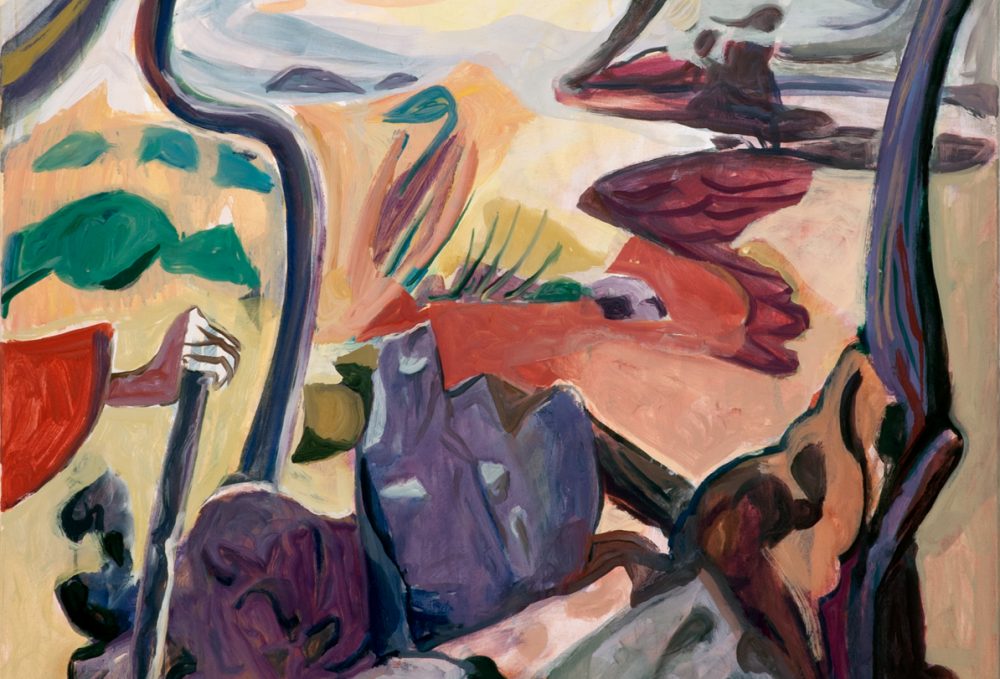
 Jackie Gendel, Comedy of Manners, 2012, oil on canvas over panel, 34″ x 44″I liked the paintings and found myself continuing to think about them, perhaps because of, rather than in spite of, their opacity. There is something really wonderful about Gendel’s ambition, as if the artist wanted to have it all — abstraction, representation, narrative, concept, process, and emotional and intellectual content, straddling both contemporary and traditional values. There is also real pleasure in her bravura handling of juicy paint and rich and strange color chords, the finesse of her slashing line drawing, and the audacity of drawing on such a range of unfashionable or difficult to integrate source material.
 Jackie Gendel, Carried Woman II, 2013, oil on canvas, 72 x 60″The most successful piece here is unique among her works that I’ve encountered: a large canvas, more crammed with heads than usual and painted in a range of styles, have been over painted with sharp edged geometrically structured white shapes. The effect is multi fold; on one hand the chaotic goings on are organized by the grid, much as the wave motif had in the other paintings. At the same time the white reads very much like a wall, visually dissolving into the white walls of the gallery, so that the painting underneath reads as a grouping of small paintings installed on a wall. However, because the white is painted on top, and with such definitiveness, it becomes a cancellation of the underneath imagery. So, the physical positive reads as negative space, while simultaneously fracturing and unifying the underneath imagery.
 Jackie Gendel, Party Line, 2013, oil on canvas, 64 x 51″This cancellation is, I believe, a core value of Gendel’s work. One of the clearest pieces in the November show was a small water based drawing in which the upper left diagonal half of the painting, an image of two figure reminiscent of Fuseli, was painted out with a not quite entirely opaque gray triangle thereby integrating and relating the drama of the pictorial fiction with the evolving painterly process.
 Jackie Gendel, Judith II,2011, Watercolor, gouache and ink on paper, 12 3/8 x 10 13/16″The press release states that in this version of the show, Gendel intended to “register the emotional high water mark of the artwork rescue effort and the conviviality that the art community fostered after the storm.” On top of that, I would argue that the shared story and experience has shifted Gendel’s paintings beyond the personal and inspired a formal leap forward in her work. Here’s to hoping that her continued evolution will take place under calmer conditions.


